
Movie Ratings Explained: What PG-13, R, TV-MA and Other Ratings Mean
Movie ratings help viewers understand the type of content they can expect before watching a film or TV show. Labels such as PG-13, R, TV-MA and TV-14 provide guidance about age suitability, language, violence and mature themes. However, these labels do not mean exactly the same thing in every country.
This guide explains what common movie and TV ratings mean, how film ratings differ from television ratings, and how to check whether a title is suitable for you or your family.
Movie Ratings Explained: How Do They Work?
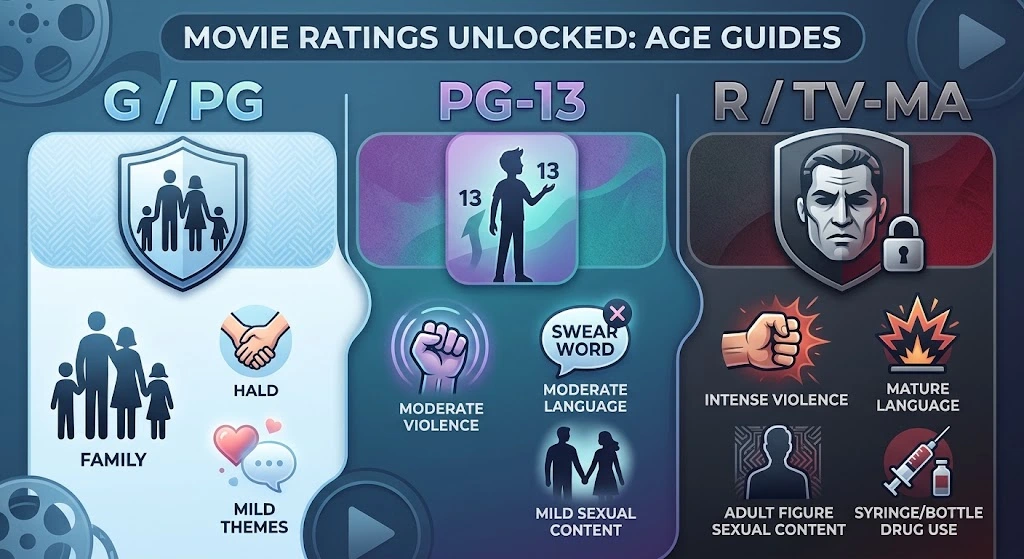
Movie ratings are classification labels used to help audiences make informed viewing decisions. Depending on the country, ratings may be assigned by a national classification authority, a regional board or an industry rating system.
A rating generally considers factors such as:
- Violence and frightening scenes
- Strong or offensive language
- Sexual content and nudity
- Drug use and other mature themes
- The overall intensity and context of the material
A rating is a guide, not a complete description of everything in a film. Two movies with the same rating can contain very different material, which is why content warnings and classification notes are useful.
Important: PG-13 and R are US film ratings, while TV-14 and TV-MA belong to the US television rating system. Other countries use their own classifications.
What Does PG-13 Mean?
G-13 means Parents Strongly Cautioned under the US Motion Picture Association (MPA) film rating system. Some material may be inappropriate for children under 13, so parents are advised to consider the content before allowing younger children to watch.
A PG-13 movie may include:
- Action violence or intense sequences
- Stronger language
- Sexual references or some sensuality
- Mature themes
- Frightening scenes or disturbing images
Not every PG-13 film contains all these elements. One movie might receive the rating because of violence, while another might receive it because of language or mature subject matter.
PG-13 is not a worldwide age classification. Other countries may assign different labels to the same film according to their own rules.
Best way to interpret it: Check the rating details and decide whether the film is appropriate for the individual viewer.
Official reference: MPA Film Ratings Guide.
What Does R-Rated Mean??
R-rated means Restricted in the US MPA film rating system. An R-rated film may contain adult material, including strong language, intense violence, sexual content, nudity or drug use.
Under the MPA’s US theatrical guidance, viewers under 17 must be accompanied by a parent or adult guardian to attend an R-rated film. This is not a universal rule for every country or every streaming service.
An R rating does not mean every film contains explicit sexual content or extreme violence. The specific reasons for the rating depend on the movie.
For example, a crime thriller may receive an R rating for intense violence and language, while a drama may receive it for sexual content or other mature material.
Best way to interpret it: Read the content descriptors rather than assuming every R-rated film has the same level or type of mature content.
What Does TV-MA Mean?
TV-MA means Mature Audience Only in the US TV Parental Guidelines system. It indicates that a television program is designed for mature audiences and may be unsuitable for viewers under 17.
A TV-MA show may contain:
- Graphic or intense violence
- Strong language
- Explicit sexual content
- Other mature themes
The rating does not mean that every TV-MA program contains all these elements. Content descriptors, when provided, help explain why a particular program received the rating.
TV-MA is a television rating, not the same classification as an R-rated movie. The two systems have different purposes and rules.
Best way to interpret it: Check the program’s content warnings and consider whether the material is suitable for the intended viewer.
What Does TV-14 Mean?
TV-14 means that a television program may contain material many parents would consider unsuitable for children under 14.
Depending on the show, this may include stronger language, violence, sexual situations or suggestive dialogue. The exact content varies between programs.
TV-14 does not mean that every scene is suitable for every teenager, nor does it mean the program necessarily contains all these types of material.
TV-14 is also not a direct equivalent of PG-13. PG-13 applies to films in the US MPA system, whereas TV-14 applies to television programs under the TV Parental Guidelines.
Best way to interpret it: Use the rating as an initial guide and read the available content descriptors before choosing a show.
G vs PG vs PG-13: What Is the Difference?
G, PG and PG-13 are three categories in the US MPA film rating system. They communicate different levels of parental guidance.
| Rating | Meaning | General guidance |
|---|---|---|
| G | General Audiences | Considered suitable for all ages |
| PG | Parental Guidance Suggested | Some material may not suit younger children |
| PG-13 | Parents Strongly Cautioned | Some material may be inappropriate for children under 13 |
G does not automatically mean a film was made specifically for children. PG does not mean that every young child will find a film suitable. PG-13 is a stronger caution, but it is not a precise measurement of violence, language or other content.
When choosing a film for a child, consider the actual content and the child’s age and sensitivities rather than relying on the label alone.
What Do TV-G, TV-PG and Other TV Ratings Mean?
The US TV Parental Guidelines system uses several labels to indicate the general suitability of television programs.
| TV rating | Meaning | General guidance |
|---|---|---|
| TV-Y | All Children | Designed for a very young audience |
| TV-Y7 | Directed to Older Children | Designed for children aged 7 and older |
| TV-G | General Audience | Generally suitable for all ages |
| TV-PG | Parental Guidance Suggested | Some material may be unsuitable for younger children |
| TV-14 | Parents Strongly Cautioned | Some material may be unsuitable for children under 14 |
| TV-MA | Mature Audience Only | Intended for mature audiences |
These are US television classifications, not universal ratings used by every streaming service worldwide.
The rating alone may not tell you exactly what appears in a program. Some listings also include content descriptors that identify the type of material viewers may encounter.
What Do TV Content Descriptors V, L, S, D and FV Mean?
In the US TV Parental Guidelines system, letters may appear alongside a program’s rating to provide more information about its content.
- V — Violence: Indicates violent content.
- L — Language: Indicates coarse or strong language.
- S — Sexual situations: Indicates sexual content or situations.
- D — Suggestive dialogue: Indicates suggestive dialogue.
- FV — Fantasy violence: Used with the TV-Y7 rating to identify fantasy violence.
For example, TV-14-V indicates a TV-14 program with a violence descriptor. TV-MA-L indicates a mature-audience program with a language descriptor.
Not every rating displays every descriptor. The letters shown depend on the program and the content being identified.
These descriptors are useful because two programs with the same rating may differ substantially in the material they contain.
Are Movie Ratings the Same Worldwide?
No. Film classification systems vary by country, and the same movie can receive different ratings in different markets.
Here are examples of classification systems viewers may encounter:
| Country or region | Examples of ratings | What to know |
|---|---|---|
| United States | G, PG, PG-13, R, NC-17 | MPA film rating system |
| United States, television | TV-Y, TV-G, TV-PG, TV-14, TV-MA | TV Parental Guidelines |
| United Kingdom | U, PG, 12A, 12, 15, 18 | BBFC classification categories |
| Australia | G, PG, M, MA 15+, R 18+ | Australian film classification categories |
| Canada | G, PG, 14A, 18A and others | Ratings and rules vary by province and territory |
These examples are not direct equivalents. A PG-13 film in the US may receive a different classification in the UK, Australia or Canada because each system applies its own criteria.
Some countries also distinguish between advisory ratings and legally restricted categories. Local rules may affect whether a younger viewer can attend a theatrical screening.
For an international audience, the safest approach is to check the classification shown in the country where the movie is being watched.
Official resources include the British Board of Film Classification, Australian Classification and MPA Film Ratings.
Does an R Rating Mean a Movie Is Better or More Mature?
No. A more restrictive rating does not automatically mean a movie has better storytelling, acting or production quality.
Ratings describe content and age guidance, not whether a film is good or bad. A PG-13 movie can explore serious themes, while an R-rated movie can be a comedy, thriller, drama or action film.
Similarly, TV-MA does not automatically mean a series is better or more sophisticated than a TV-14 show.
If you want to decide whether a title is worth watching, consider its storyline, genre, reviews and personal preferences alongside its rating.
How to Check a Movie’s Rating Before Watching
Use these steps to make a more informed choice:
- Confirm the exact title and release year. This helps avoid confusing films with similar names.
- Identify the rating system. Check whether the label comes from the MPA, TV Parental Guidelines or another country’s classification authority.
- Read the content descriptors. Look for information about violence, language, sexual content or other mature themes.
- Check the country-specific rating. Do not assume a US rating is the official classification in every region.
- Consider the intended viewer. Individual sensitivities and family preferences matter as well as age.
- Check the version where relevant. Different edits or releases may have different classifications.
For US films, FilmRatings.com provides official MPA rating information. For US television programs, TVGuidelines.org explains the TV Parental Guidelines. For other countries, use the relevant local classification authority.
Final Thoughts
Movie ratings explained simply: PG-13 and R are US film ratings, while TV-14 and TV-MA are US television ratings. They help viewers understand potential content concerns, but they are not universal classifications and should not be treated as exact equivalents.
For the most useful guidance, check the rating, read its content descriptors and confirm the classification used in your country. This gives you a clearer understanding of what to expect before watching a film or TV show.


